Category Archives: Brainpower

Girl Crush: Sarah Koenig

sarah koenig 1

I’ve been a long-time lover of This American Life but recently my girl crush on staff producer Sarah Koenig has been through the roof! A few weeks ago, TAL aired an episode that also served as the first episode for a spin-off podcast called Serial. I was immediately hooked. Sarah’s poignant journalism and writing is unparalleled. Over the course of the season, Serial is unfolding just one non-fiction story–in this case, a story about a murder and high school sweethearts and a man’s claimed innocence. Basically, a tale you want to tune in for.  And they promise to keep telling the story until they “get to the bottom of it”.

This is all to say, I’m completely obsessed with Sarah Koenig. I want to be her. If you haven’t checked out Serial yet you totally should. No one could tell this story like her.

P.S. Here are some of Ms. Koenig’s best-loved This American Life episodes and one of my favorite episodes that I still talk about all the time.


(Photo by Meredith Heuer.)


A boy and his phone.

boyandtrain

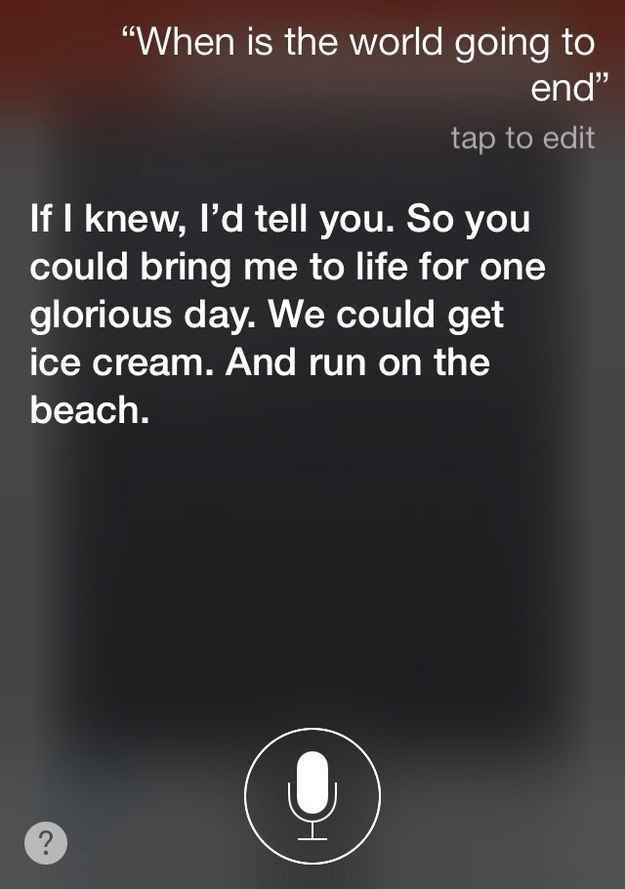
I like turning to Siri, my iPhone’s “intelligent personal assistant”, when I’m otherwise too preoccupied to dial, Google or find directions for myself. But a recent New York Times Article–To Siri, With Love: How One Boy With Autism Became B.F.F.’s With Apple’s Siri, suggests her at-the-touch-of-a-button presence, for some, could be much more powerful and much more profound:

Gus had never noticed Siri before, but when he discovered there was someone who would not just find information on his various obsessions (trains, planes, buses, escalators and, of course, anything related to weather) but actually semi-discuss these subjects tirelessly, he was hooked. And I was grateful. Now, when my head was about to explode if I had to have another conversation about the chance of tornadoes in Kansas City, Mo., I could reply brightly: “Hey! Why don’t you ask Siri?”…
She is also wonderful for someone who doesn’t pick up on social cues: Siri’s responses are not entirely predictable, but they are predictably kind — even when Gus is brusque. I heard him talking to Siri about music, and Siri offered some suggestions. “I don’t like that kind of music,” Gus snapped. Siri replied, “You’re certainly entitled to your opinion.” Siri’s politeness reminded Gus what he owed Siri. “Thank you for that music, though,” Gus said. Siri replied, “You don’t need to thank me.” “Oh, yes,” Gus added emphatically, “I do.”…
For most of us, Siri is merely a momentary diversion. But for some, it’s more. My son’s practice conversation with Siri is translating into more facility with actual humans. Yesterday I had the longest conversation with him that I’ve ever had. Admittedly, it was about different species of turtles and whether I preferred the red-eared slider to the diamond-backed terrapin. This might not have been my choice of topic, but it was back and forth, and it followed a logical trajectory. I can promise you that for most of my beautiful son’s 13 years of existence, that has not been the case… 
Last night, as he was going to bed, there was this matter-of-fact exchange:
Gus: “Siri, will you marry me?”
Siri: “I’m not the marrying kind.”
Gus: “I mean, not now. I’m a kid. I mean when I’m grown up.”
Siri: “My end user agreement does not include marriage.”
Gus: “Oh, O.K.”
Gus didn’t sound too disappointed. This was useful information to have, and for me too, since it was the first time I knew that he actually thought about marriage. He turned over to go to sleep:
Gus: “Goodnight, Siri. Will you sleep well tonight?”
Siri: “I don’t need much sleep, but it’s nice of you to ask.”

boytelescope

siriquote

Thoughts? It’s amazing to see unintended, positive outcomes within technological advances and even MORE amazing to see developers taking stories like these and running with the information in order to increase efficacy and outreach. Definitely check out the full article for more information on the future of this helpful technology.

P.S. Remember this fantastic article about a father reaching his autistic son with the help of Disney characters? And check out my weekly mid-week round-ups for even MORE reading material!

Escape from the Quiverfull movement.

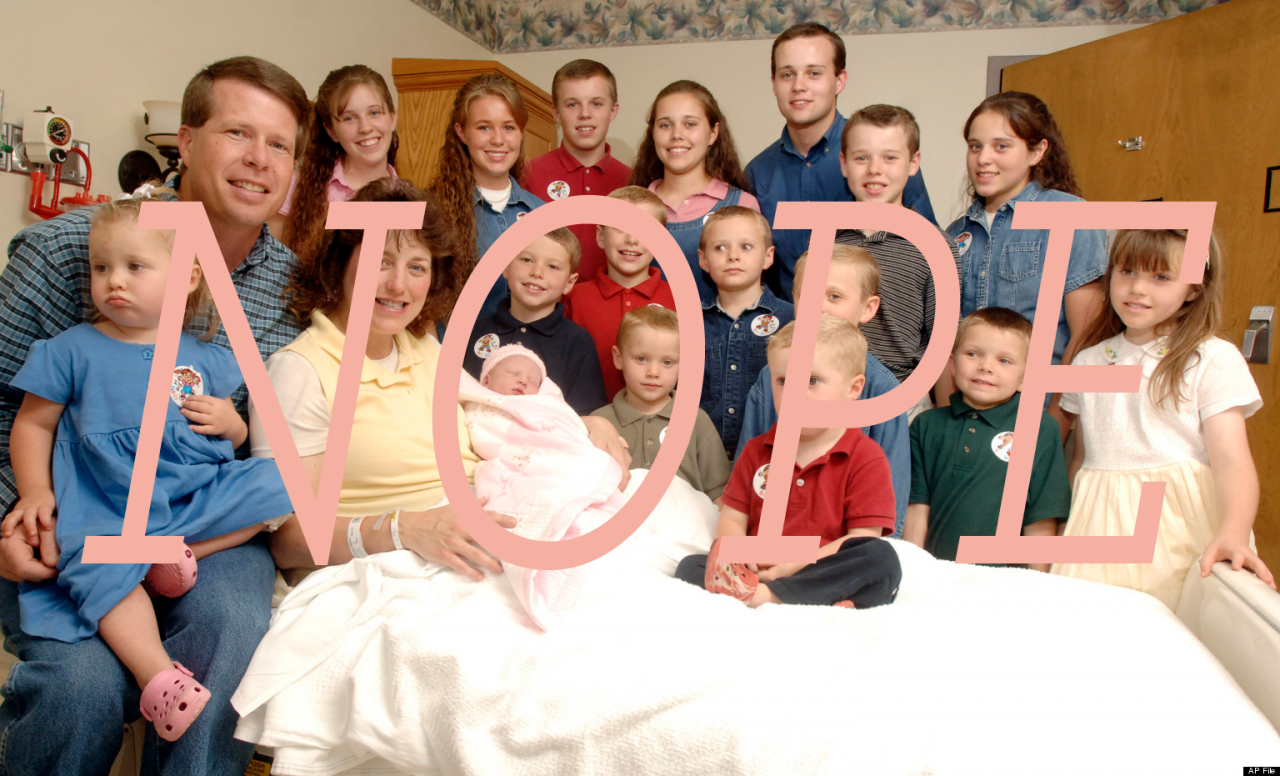
duggarsnope

Yesterday, I read an excerpt from Vyckie Garrison’s remarks to American Atheists about her escape from the oppressive confines of the Quiverfull movement. Much like reality TV’s Duggar family, Garrison belonged to a devout Christian family, their values informed by literalist interpretations of scripture.

The Quiverfull movement is comprised of fundamentalist families who aim to live the biblical model of marriage and child bearing/rearing. The Bible dictates that children are blessings–“As arrows in the hand of the mighty man, so are the children of ones youth, happy is the man who hath his quiver full of them.” Quiverfull couples leave family planning in the Lord’s hands and women willingly remain pregnant, nursing or both for the majority of their adult lives.

As Garrison explains:

“Probably the most recognizable and influential Quiverfull family in America is reality TV’s Duggar Family of “Way Too Many and Counting” fame. But unlike fundamentalist Mormons who tend to congregate in just a few places in Utah, Arizona, Texas, etc., you will find Quiverfull families in nearly all types of churches in every community. This is because Quiverfull is not a denomination, with a creed to sign and a church to join. And it’s not technically a cult in the strict sense of having one central leader … instead, Quiverfull is a mindset (a very powerful head trip) in which each family becomes a cult unto itself with Daddy enshrined as the supreme Patriarch.”

and

“So this was about political domination. The whole point of having a quiver full of babies is to … out-populate the “enemy,” … that would be all of you; and to shoot those many arrows “straight into the heart of the enemy.” And by that, we meant that our children would grow up to be leaders in all the major institutions of our society. This was our plan for taking back America for God. So the children were like arrows (which is the ammunition) in God’s holy war.”

Garrison goes on to share how, while she initially did not have the language to identify her lifestyle as abusive, her exposure to a “Power and Control Wheel” helped her identify the ways in which she had been manipulated, exploited, mistreated and enslaved. Her story is a compelling one. The parallels between a Quiverfull family unit and a patriarchal cult ring true. Certainly the manipulation and isolation are present but also the over-arching use of militaristic rhetoric as expression of the group’s mission–a very common and powerful tactic in many modern cults.

I worry about women in entrapment similar to Garrison’s (and their children, too). I’m glad she  is raising her voice.

You can watch her full speech below. She also blogs at No Longer Quivering.

(top photo via here.)

Pet Peeves: Mondegreens!

mondegreens

The other day, while watching “Keeping up with the Kardashians” and chatting with Chet online, sister Khloe K. confidently described a situation punctuated with one of my biggest pet-peeves. Khloe, waxing poetic about her jet-setting life of promoting Sears clothes and general alliterative expression, remarked that the past few weeks had been a WORLD-WIND. “Ugh,” I typed to Chet, “I hate it when people say world-wind instead of whirl-wind!” (Really I hate any number of examples like this…basically, close but no cigar utterances of words and phrases where the speaker has THE AUDACITY to misspeak with such confidence! LOL) He excitedly remarked, “That’s a mondegreen!” Mondegreens, he explained, are the wrong words that come about from mishearing or misinterpreting a statement, song lyric or line.

“People confuse world-wind and whirl-wind because the two utterances world and whirl are in near homophony. Homophonous pairs sound exactly the same but mean different things, like bear and bare. Near homophonous is when they are very close.”  How cute is he? I love stuff like that. And because I’m a word-nerd, I decided to research a few fun examples.

So, these happen a lot in song lyrics because we’re just LISTENING to the song and don’t often see the lyrics written down. Like,

“The girl with colitis goes by” instead of “the girl with kaleidoscope eyes” in the Beatles’ Lucy in the Sky with Diamonds

or

“There’s a bathroom on the right” instead of “There’s a bad moon on the rise” in CCR’s Bad Moon Rising.

But there are also some fun historical examples where the earlier versions of English words were different than what we know today. Over time, after years of mishearing and repeating, the accepted standard English is now the mondegreen. Spit and image is now spitting image, Welsh rabbit is now Welsh rarebit, an ekename is now a nickname. And my absolute favorite: what we now call an orange was once A NARANJ. Which makes a whole lot more sense if you look at the etymology of that word.

I also love this quotation:

“No language, how simple soever, I think, can escape a child’s perversion. One said for years, in repeating the ‘Hail, Mary!’ ‘Blessed art thou, a monk swimming.’ Another, supposing that life was labour, I presume, ended his prayers with ‘forever endeavour, Amen.'”

-John B. Tabb, “Misconceptions.” The Academy, Oct. 28, 1899

Who knew the Kardashians could spark such a grammar lesson! (Though I have to admit, I’d really prefer it if someone (perfect world: Kanye or Brody Jenner) would tweet something at Khloe that included the word whirl-wind so she could have a moment of clarity and realize the mistake she’s been making her whole life. Cuz those moments are awesome. Legit, one of my (in her 60’s) co-workers realized the other day that she’d been saying cold-slaw instead of cole-slaw her whole life and it was awesome.)

Have you been guilty of any mondegreens in your past? SPILL! I promise not to judge. And what are YOUR biggest pet peeves? 

Top photo via here.

Please read Suspicion Nation.

suspicionnation

In the wake of the recent tragedy in Ferguson, Missouri, where yet another one of our black youths was brutally shot and killed, my brain went into overdrive with questions. Why do we keep letting this happen? How many more mothers must bury their sons before we value human life more than guns? Why must we time and time again equate dark skin with fear and suspicion? Why is this fear perpetuated every time someone tries to warn, protect or dissuade me from going into an area populated by a race not my own? Seeking answers, I did what any analytically minded, life-long learner and non-fiction junkie would do–I bumped a book up on my reading list.

A few years ago I read Lisa Bloom’s Think: Straight Talk for Women to Stay Smart in a Dumbed Down World and fell in love with both the book’s message and it’s attorney turned journalist author. I read books she recommended, kept up with opinion pieces she put out and followed her on Twitter. Later, when I became baffled by what I saw going on in the courtroom during the George Zimmerman trial, I turned to her NBC legal analysis for clarity. She tracked, researched and reported on this trial from gavel to gavel. And the story…the INJUSTICE…the (excuse my language) bumblefuck of a job the prosecution did…got under her skin. And rightly so. Because Trayvon Martin is not the first black kid to lose his life while a killer walks free. He wasn’t the last. So Bloom got to work; articulating what happened and why it KEEPS happening.

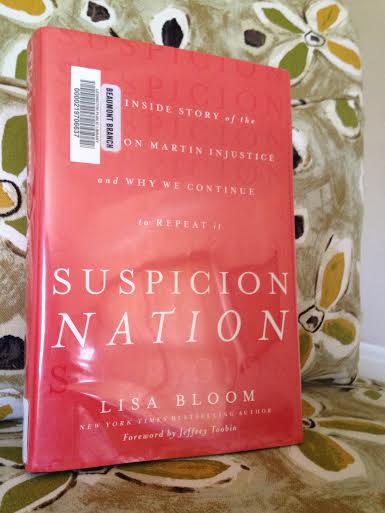
What emerged was the fantastic book Suspicion Nation: The Inside Story of the Trayvon Martin Injustice and Why We Continue to Repeat It. If Mike Brown’s murder has affected you, as it did me, please read this book. From a play-by-play legal analysis as to how Zimmerman walked away with an acquittal to a candid portrait of our country’s racial biases, Bloom’s book is a chilling depiction of the state things are in. But it’s not without solutions. And when you read it, you’ll probably think of a few of your own, too. Even if they’re small steps, we HAVE to do better. Acknowledging the systematic barriers forming a blockade around our country’s young, African-American males is a great place to start.


Connecting the book, Bloom and Ferguson–


Lisa Bloom is part of the Michael Brown Justice Panel, a group of legal professionals working to stop the shootings of unarmed black men.


Suspicion Nation was selected as a #FergusonReads book.


Part 1 and Part 2 of an interview with Bloom on the book and lessons for Ferguson.


A rather grim hypothetical.

parkinglot

A few weeks ago, I walked into a conversation between two of my co-workers wherein one was asking the other the rather macabre question, “Can you imagine a situation in which you would forget your baby was in the car with you?” New mother and resident recipient of all our childless, curiosity-driven questions, coworker number 2 emphatically answered; no, she could not imagine such a thing, her mommy senses were too strong. Butting my way into the conversation, I agreed; no, surely, if one was sober, mother or not you would just SENSE another person in the vehicle with you. I love hypotheticals as a means of making small-talk interesting and I’m sure by now you see where this particular hypothetical leads…if you DID forget your baby was in the car with you and you left it and it was hot out…the baby dies. A scenario which, if you consume any sort of news media, is repeated again and again…and again. Especially this time of year. In response to the hypothetical, all three of us were insistent that this would never happen to us. But it does happen. A lot.

My co-worker presenting the question had just read Gene Weingarten’s 2009 article Fatal Distraction: Forgetting a Child in the Backseat of a Car Is a Horrifying Mistake. Is It a Crime? from The Washington Post Magazine. She explained that the article posited, it’s way easier than we would think. My interest totally piqued, I pulled up the article that night after work and was completely sucked in. Longform journalism at it’s finest, the story is presented with twists and turns, heartbreaking personal accounts and bone-chilling statistics. But for me, it also flipped the stereotype I had in my head about the person who may, in completely undressed up language, accidentally kill their own kid. When I’d heard stories about this phenomenon in the past, my mind would draw up some drug-addled, barely functioning parent who, maybe not totally maliciously, was more focused on scoring their next high than caring for their offspring. Boy, was I wrong.


Here’s a teaser from the article, if you’d like a taste:


“Death by hyperthermia” is the official designation. When it happens to young children, the facts are often the same: An otherwise loving and attentive parent one day gets busy, or distracted, or upset, or confused by a change in his or her daily routine, and just… forgets a child is in the car. It happens that way somewhere in the United States 15 to 25 times a year, parceled out through the spring, summer and early fall…

Two decades ago, this was relatively rare. But in the early 1990s, car-safety experts declared that passenger-side front airbags could kill children, and they recommended that child seats be moved to the back of the car; then, for even more safety for the very young, that the baby seats be pivoted to face the rear. If few foresaw the tragic consequence of the lessened visibility of the child . . . well, who can blame them? What kind of person forgets a baby?

The wealthy do, it turns out. And the poor, and the middle class. Parents of all ages and ethnicities do it. Mothers are just as likely to do it as fathers. It happens to the chronically absent-minded and to the fanatically organized, to the college-educated and to the marginally literate. In the last 10 years, it has happened to a dentist. A postal clerk. A social worker. A police officer. An accountant. A soldier. A paralegal. An electrician. A Protestant clergyman. A rabbinical student. A nurse. A construction worker. An assistant principal. It happened to a mental health counselor, a college professor and a pizza chef. It happened to a pediatrician. It happened to a rocket scientist.

Last year it happened three times in one day, the worst day so far in the worst year so far in a phenomenon that gives no sign of abating.

The facts in each case differ a little, but always there is the terrible moment when the parent realizes what he or she has done, often through a phone call from a spouse or caregiver. This is followed by a frantic sprint to the car. What awaits there is the worst thing in the world.

***

The article goes on to examine whether this atrocity is a court-ordered, punishable offense or whether the self-prescribed, guilt-ridden hell these parents must reside in for the there-after is punishment enough. After all, they have already lost their child. Weingarten cites statistics gathered by a childs’ safety advocacy group. 40% of these incidents are evaluated by the courts and deemed a horrific accident. 60% are aggressively pursued as a felony.

Wherever you fall in terms of how you think cases like these should be addressed, I recommend giving this article a read. It’s a riveting investigation into these parents’ fatal distraction. And your reaction to Weingarten’s words may very well surprise you.


Our storytelling minds.

rainydayinfall

A few days ago, I finished reading The Storytelling Animal: How Stories Make Us Human by Jonathan Gottshcall. In it, Gottschall presents a unique theory–that stories assist humans in navigating the complex social problems we encounter throughout our lives. Likening storytelling to flight simulators, which allow pilots to learn while on the ground, we live out a multitude of situations through the landscapes of make believe which are later applicable to our reality. Storytelling has evolved, he argues, in order to help keep us alive. There are many aspects of this book which I found fascinating–linking narrative to psychology, neuroscience and evolutionary biology. Not to mention, highlighting instances where a story changed the course of history (think Wagner’s Rienzi‘s influence on Hitler, Uncle Tom’s Cabin setting the stage for the most terrible war in American history, and the economic impact of Jaws on coastal vacation destinations).

There is another link, however, between narrative and mental illness. After the passing of yet another beloved performer, artist and storyteller who suffered from depression and addiction, the implications of this connection seem exceptionally pertinent. Gottschall points to the psychiatrist Arnold Ludwig’s study of mental illness and creativity which found far higher rates of psychiatric disorders in artistic fields than say political, scientific or business. Perhaps, the book points out, those with mental disorders are drawn towards creative outlets because of the stories they can create there. Stories which can give structure to what is going on inside their heads. Sometimes these stories are what bring us The Starry Night or Mrs. Dalloway and sometimes these stories go terribly awry. At times, there is a tragic cost for having storytelling minds.

So, what does that mean for us? In the wake of Robin William’s passing, diminishing the stigma of mental illness is again on the minds of many. Helping those suffering is a cause worth fighting for and believing in…but how do we do it? Personally, this is something I’ve been trying to find the answer to for some time. And one passage in Gottschall’s book really stood out to me. While it speaks to the success of psychotherapy, I found it an interesting analogy to help me better conceive of depression and it’s effects on the affected brain and person.

According to the psychologist Michele Crossley, depression frequently stems from an “incoherent story,” an “inadequate narrative account of oneself,” or “a life story gone awry.” Psychotherapy helps unhappy people set their life stories straight; it literally gives them a story they can live with…A psychotherapist can therefore be seen as a kind of script doctor who helps patients revise their life stories so that they can play the role of protagonists again–suffering and flawed protagonists, to be sure, but protagonists who are moving toward the light.

We each live the story of our lives. Our stories change and intersect, get written and edited and re-written…and sometimes we need reminders that we are the heroes in our own stories. And so that is how I am resolved to help, to continuously write chapters into my own story in which I name the heroes of others.


(Painting via here.)


An (UN)arranged marriage.

KONICA MINOLTA DIGITAL CAMERA

A few weeks ago, I was struck by this interview on NPR’s Weekend Edition Sunday with Fraidy Reiss, a woman whose religion and culture dictated when and whom she should wed. At 19 and an abusive man who later, when Reiss was reaching out for help, elders in her community would defend as simply having “a little bit of a temper.”

After leaving her husband and the Ultra-Orthodox Jewish community, she founded a non-profit organization to help other women escape arranged marriages. Because guess what? Women being manipulated in the name of God, their heritage, family pride, or some twisted take on tradition happens in America way more often than we care to realize.

It is hard to determine just how many arranged marriages occur in the United States each year but what we do know is that most states lack the legislation to protect women when they go wrong.

Reiss was partnered with her husband by a professional matchmaker, a common occurrence in the Orthodox Jewish community. “It never occurred to me that I was doing anything other than what I had always dreamed of doing,” she says. But, merely one week into married existence, Reiss discovered that life with this stranger was not headed towards wedded bliss. After her family and multiple rabbis refused to assist the young bride, she looked else where…

From the accompanying NPR article:

After a particularly violent episode, Reiss says, she went to the police to get a temporary restraining order, a first for a woman in her community. That was a mistake, she says.

“I realized too late that one of the gravest sins in the Orthodox Jewish community is ratting out your fellow Jew to secular authorities,” she says. The rabbis sent an attorney from the community to Reiss’ house to drive with her to family court and tell the judge she wanted to drop the restraining order.

After getting a degree and a job, Reiss was finally able to take her 2 children and leave the marriage. She was promptly declared dead by the rest of her family and shunned.

However, Reiss would go on to found Unchained At Last, a non-profit organization which helps women like her escape forced or arranged marriages–offering free legal counsel, social services and a mentor program. For many of these women, this way of life is the only one they know and they have no one to help them. Conversely, Unchained At Last envisions a world where women are free to choose when, whom and whether they marry.

If you’d like to listen to the NPR interview with Fraidy Reiss CLICK HERE.

If you’d like to check out the fantastic organization, Unchained At Last CLICK HERE.

And if this story strikes you, as it did me, I strongly encourage you to make a donation HERE.

Carol Rossetti’s colorful illustrations of female empowerment.

rossetti5

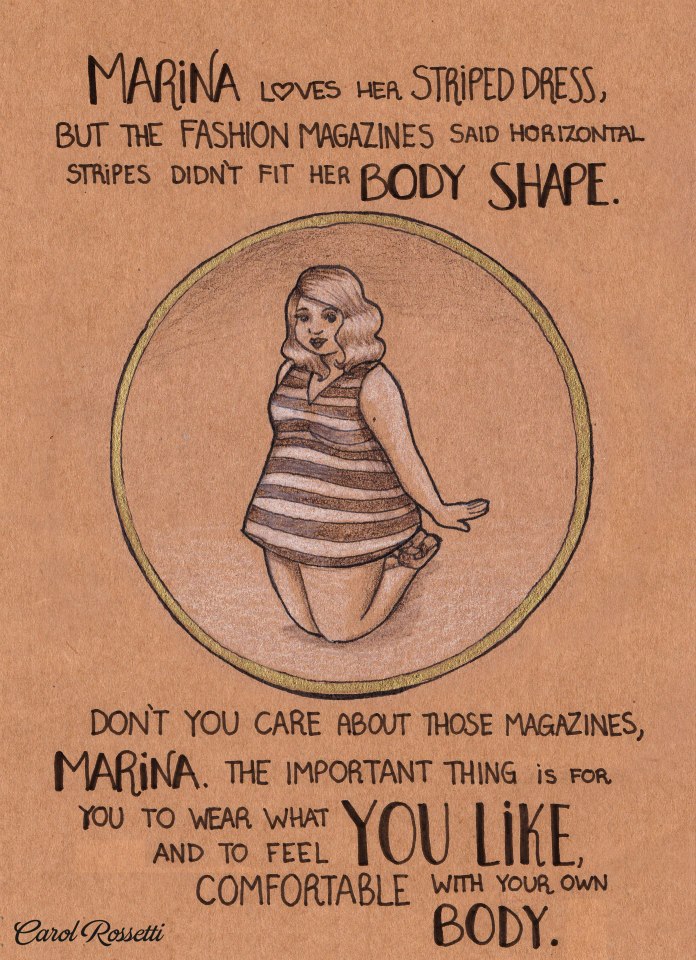
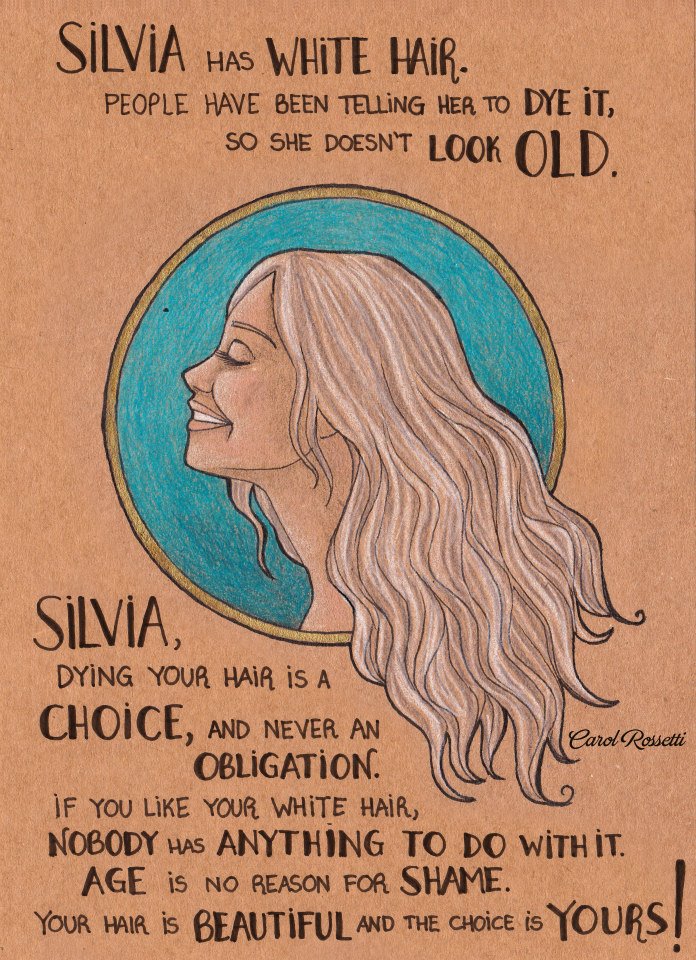
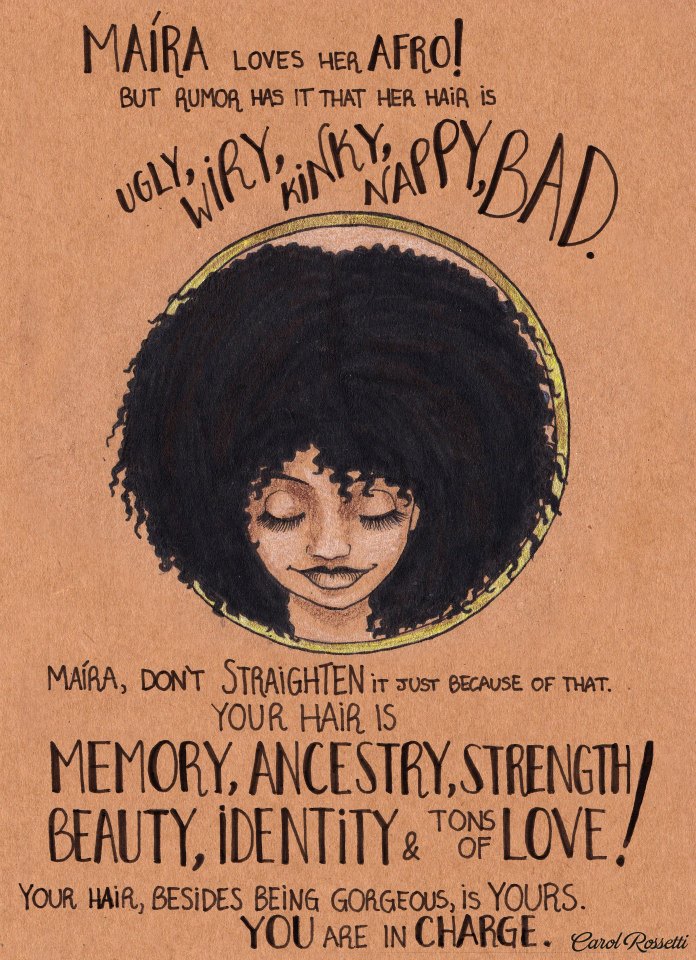
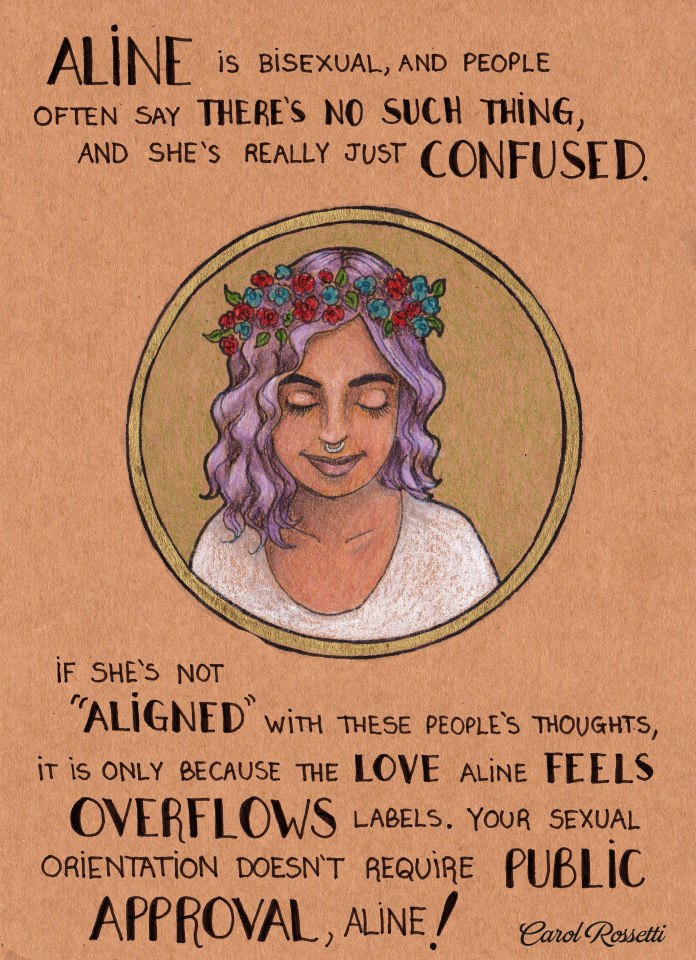
By now I’m sure you’ve seen these empowering illustrations by Carol Rossetti but I thought I’d share just in case. Rossetti, a graphic designer from Brazil, began posting these colorful gems on her Facebook page to highlight the stories of real women she’d encountered. She answers the oppression within each situation with encouragement. In this way, they serve as a sort of declaration of women’s corporeal autonomy. And I think they’re really rad.

rossetti6

rosetti1

rossetti2

rossetti3

rossetti4

Aren’t they wonderful? I’m totally obsessed. You can see the entire collection in her Facebook photo album here.

Strawberry Walks into Bar.

girlwalksintobar1

I just finished this book, girl walks into a bar. by Strawberry Saroyan, that I scored last year at the Friends of the Library book sale for a buck. While at times the memoir feels a bit banal, it does paint a clear picture of life in the magazine (and pseudo-famous) world of the angst-riddled 90’s. The memoir is split into chapters which read more like individual essays as opposed to supporting an over-arching story, yet thematically they all work in the context of the title–Saroyan seems to have “come of age” so to speak in the various bars she frequented.

strawberry

Here she discusses her ritual of going to bars every Thursday night with a group of friends she made after moving cross country in her mid-20’s:

We weren’t just people who hung out at a bar one evening a week together, trying to valet our screwed-up cars as discreetly as possible before dashing in in our fancy duds. We were friends. For even though they’d all seemed so glittering to me, the truth was we were all, to varying degrees, alone: Rich or poor, ascending or not, we were almost all professionally freelance, and personally single.

We were all edging toward thirty, too, without the family and kids that some of us had been taught to expect by this time, but even more than that, without the sense of being adults that had been implicitly promised us. None of us felt like adults. And it’s something that I’ve still rarely heard acknowledged, but that I find to be almost frighteningly true: No one ever tells you that you’re never going to feel grown-up.

Proto Lena Dunham Lena Dunham-y, amirite? Basically, if you find hipster-y lifestyle blogs and Girls entertaining and painfully relatable I think you’ll dig this book. (And the last essay reads a bit like Frances Ha.) Just don’t go into it expecting a narrative because all you’re gonna get are some general quarter-life crises musings.

girlwalksintobar2

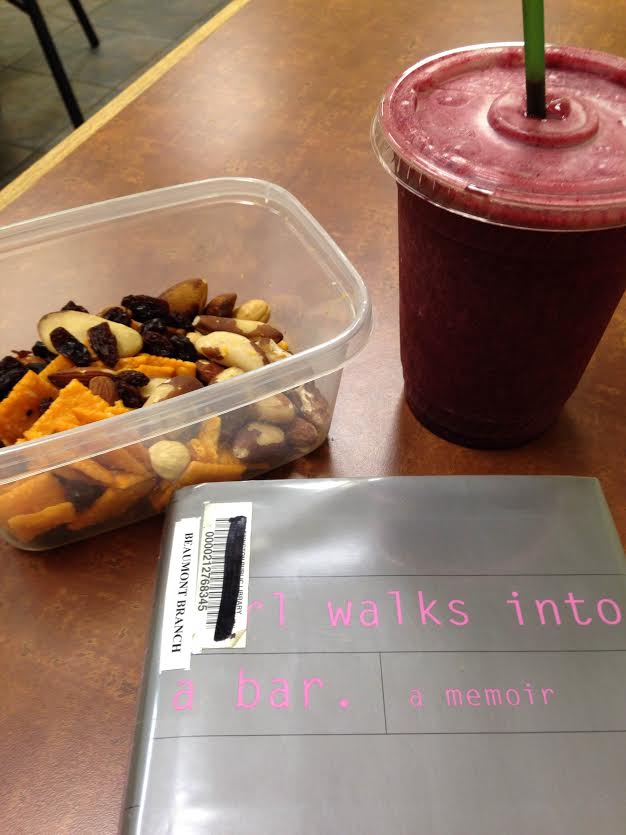
I enjoyed this book best while munching on self-made trail mix and drinking a berry smoothie. My favorite of the essays was the bounty boys.

P.S. Check out this piece Strawberry wrote for The New York Times in 2004 after Gwyneth Paltrow named her daughter Apple. Those fruit-named gals have to stick together, I suppose.